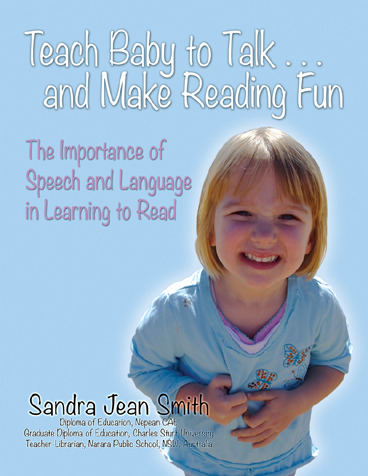
 I decided to write this book due to a growing sense of concern as I realised that between 20%-25 % of children from English speaking backgrounds were coming to school with a complex variety of speech problems which were hitherto unknown.
The topic of this book is of major interest to teachers ,parents of infants to pre-school age children and those who work and care for young children. I have been giving the substance of this book as a talk to parents of school age children and pre-school parents for the past 5 years and have received many thanks as people were not aware of the growing problems with speech in young children.
On Monday morning 19th March,2007 I was interviewed by Virginia Trioli on 702 ABC Radio Sydney in regard to a discussion on the high incidence of Kindergarten children coming to school with speech problems compared to children in the past.It had been announced that morning that the Primary Principals Association of NSW had issued a press statement that they felt this problem was emerging due to children watching too much Television and using computer games.
I then sent an email to Virginia informing her of my research and would she like to read it as background information into the problem.
Instead Kathryn Mackenzie, her producer contacted me and requested would I like to be interviewed live to air!
The interview lasted approximately 10 mins including questions from callers.
At the end of the interview Kathryn Mackenzie told me they had been inundated with calls from parents wanting to discuss the issues raised.
This is a new problem in western societies throughout the world which has only recently surfaced in the last five years.
In October 2009 I attended a workshop run by the State Library of NSW from Washington State Library in Seattle entitled:” Opening the Doors to Early Literacy “
American Children’s librarians Shannon C. Schingl and Dr James Thomas ,and children’s entertainer Nancy Stewart conducted separate sessions on the importance of developing early literacy skills in babies and young children. They demonstrated and spoke about how to develop these skills through reading to , talking with , singing to and playing with babies and children and how important these skills were as the first step in being ready for school.
I was amazed that they were having the same problems emerging in the USA as I and many other teachers were beginning to become concerned about.
Since then I have written and previewed my book with several groups of young parents.
Here is a quote from an email I received from Cam and Danni St Clair, broadcasters at 2GO Southern Cross Radio group and parents of two small children after they had read one ofmy earlier drafts.
“Sandra, REALLY interesting stuff…………….It would be wonderful if it could be availableto all parents …….You learn all about feeding, bathing and playing with your baby, but never reading to them. Seemed fairly obvious to us, but as you say, most parents just wait till school, and hope the teachers will be there to pick up the pieces. …..Good luck with it…love to hear the outcome Danni”
I have also been in contact with Steven Biddulph author of many best selling parenting and family life books including “The Secret of Happy Children” , “Raising Boys” and “The New Manhood”
He has very generously been acting as my mentor throughout the last three years .He has read several successive drafts and has been advising me on ways to improve my work. This is a quote from his recent letter after reading my latest drafts.
“ Dear Sandra
Please get this book into print, its very important ,with a simple heartfelt message: credible as it is “from the coalface” .
You have an appealing and distinct personality which comes through “
The style of my book is “parent friendly” in that I have tried to include humour and anecdotes from my teaching experience to entertain as well as inform the reader.
However the content covers topics which are very current in the media i.e. childcare issues, parenting issues and the problems associated with children learning to speak and the consequent implications for learning to read. It also deals with the latest research into these problems and what parents can do to prevent them or seek help to rectify them.
I also discuss the importance and relevance of the library in stimulating and extending children’s interest in reading and also helping to counteract the influence of computer games, television etc.
 teachbabytotalk