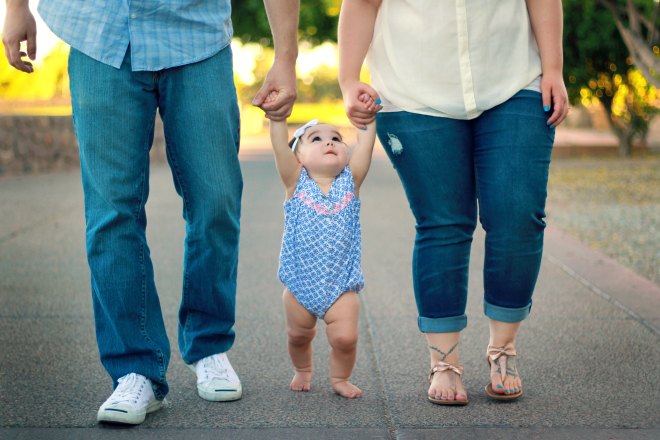
The types of activities you need to interest babies to toddlers in, to develop their language skills can roughly be divided into eight different areas, although they will cross over more often than not.
All of these activities involve active, side-by-side learning. They are:
Fine Motor Skills. The skills needed to learn to write, draw, and cut out, and create with the hands.
Arts/Crafts. Creative play with anything out of the Making Box as well as drawing, painting, cutting
out and gluing.
Cognitive. Thinking skills. These activities present a problem which has to be solved.
Social/Dramatic. Playing with toys, playing roles in the home corner, playing cooperatively with such
items as cars, blocks, and Lego.
Story/Language. Reading of stories and nursery rhymes. Playing with the “Feely” Bag and using
descriptive language.
Music/Movement. Listening to their favorite songs and dancing and singing along.
Personal/Self-Help. Activities which promote independence in how to manage themselves and their
belongings.
Gross Motor/Outdoors. Climbing, balancing, skipping, sand pit play, catching, hitting a ball, throwing
a ball.
Fine motor skills
Playdough. Such skills are provided by using play dough. Play dough that is bought or made at home are both suitable. When children use play dough to make shapes, they pound, roll, and stretch the play
dough. While doing this they are using and developing the small muscles in the fingers and hands.
Uncooked Play Dough
2 cups of plain flour
4 tablespoons of cream of tartar
2 tablespoons of cooking oil
1 cup of salt
2 cups of boiling water
Food coloring
Just put it all in a mixing bowl and mix! It looks as though it is not going to mix well at first but hang
in there and throw it onto the kitchen bench to knead, and it will come together really nicely. You can
also put different things into it such as glitter. You can also add peppermint oil for a great smell and even
longer-lasting play dough.
Large pieces of chalk on boards and paths and large crayons on cardboard and paper (recycled if possible). Drawing pictures, writing letters and numbers also promote the development of little muscles
in little hands.
Bead Threading and Sewing Cards. Bead threading large beads onto plastic tubing is best left until children
have got past the stage of putting everything into their mouths, so around 3–4 years is preferable.
When they have a variety of colored beads they can be encouraged to make bead patterns. Using the language of “same and different,” the children are being exposed to early mathematical concepts. Sewing cards are a similar activity.
You can buy commercial ones from most toy shops but you can easily make some of your own.
Use stiff cardboard to trace on simple shapes such as squares, circles, triangles, and rectangles. You can also trace around large objects or toys such as dolls and teddies. Trace an outline onto the blank side
of the cardboard if you are recycling. Holes are then put into the cardboard at regular spaces with a hole punch and the children can thread wool on a large blunt needle or stiff plastic tubing through the holes in the cardboard, weaving in and out to make a picture.
Arts and Crafts
Creative play with paints, textas, scissors, glue sticks, and sticky tape to create little pictures or play
objects such as cars. (A cardboard box they can fit into and some paper plate wheels will provide hours
of fun for a child from 2–4 years old.)
Cognitive skills are thinking skills
Jigsaw puzzles are really important for developing children’s thinking and problem solving skills.
Jigsaw puzzles made of wood are probably likely to last much longer than other materials and are readily
available from children’s toy shops.
You can also create your own jigsaw puzzles with your children by looking for large, brightly-colored photographs in old magazines. You can clip the picture, and paste it onto old cardboard, and then cut it
into large puzzle pieces. Have the children reassemble the pieces into the picture and later store them in
sandwich bags for reuse.
Plastic figures such as farm animal sets provide opportunities for thinking skills development.
Children can make a farm using their animals and farm buildings using small boxes and other materials from
the “making box.” Similar activities can be fun using zoo animals, especially after you have just visited the zoo. You can find matching pairs and groups of animals that go together such as all mammals and
amphibians, or those that live on the land or in the sea.
Group things that are alike and different.
• Clothes pegs
• Toys by color, shape, texture, type (wheels or no wheels?)
• Lego by color, Lego by shape
• Clothes off the line—all the towels together, all the socks and undies that belong to Dad, Mom,
and children
• Using both groups of toy animals, you can sort them into farm animals or wild animals. You can
use anything, really.
This grouping of objects promotes literacy skills as well as math concepts. Counting songs and
rhymes such as “Three Little Ducks” and “This Little Piggy Went to Market” are all about learning number
names, learning letter sounds, and learning words. These are all thinking skills.
Social / dramatic
This is play that involves the child becoming someone else. This can involve a simple game of “You can be Mum and I’ll be Dad” or dressing up to play the part. Keep a box of old shirts, dresses, hats, discarded
jewelry, and old shoes for this kind of play. Children love old uniform clothing and hats.
Tents and cubbies provide children with great venues for imaginative social play. Imaginative play is very important for children to process experiences in the world around them into their minds. You may be
surprised by the intensity of the play and language that emerges from it.
Story / language
When you share books by reading to your babies and children, you are helping them take their first steps in learning to read. Children soon learn that stories are about the world, what’s in it, and how it works, encompassing animals, friends, and relationships, families, and family life.
Drawing and scribbling are about learning to write and learning that reading and writing are all about communication, interaction, and socializing. Everything that involves talking, listening, and singing, and
reading and drawing and writing are helping your baby’s brain to grow!
The “feely” bag
This is a small drawstring bag about the same size as a small library bag. Every day you place a different
item, something the children are familiar with, like a key, button, spoon, soft toys, pieces of Lego,
etc. into the bag without your child seeing what it is.
Then you have the child put one of her hands into the bag and try to guess what it is by feeling the shape and discussing how it feels. You can guide her thinking by asking questions such as: Is it hard or soft ? Is it round or does it have corners? Does it have holes? Is it flat or bumpy?
Children love the mystery and love it when their guess is right. If they can’t guess it you show them
and put it away for another turn in the future. They will remember how it feels and will be so excited when
they guess correctly the next time.
Music and movement
Music powers the brain: simply singing with a child connects nerve pathways in their brain, and increases the ability of the brain to retain information. Music builds a strong sense of rhythm, which in turn leads to a better ability to understand and produce language. Singing and dancing help with the development of gross motor skills as well. There are many commercially produced CDs and DVDs made just for them. This is one area of children’s development which is well catered for these days.
Personal / self-help activities that promote independence
How to get dressed by themselves, tie shoelaces, turn their cardigan or pullover the right way around
and put it on are all important self-management skills. Some others are:
a. Putting away their toys and other playthings.
b. How to use the toilet on their own, washing their hands after doing so.
c. How to blow their nose when they have a cold.
These skills need to be well on the way to being mastered before children get to school. It makes your child feel more self-confident and independent. When children go to school they will have to look after
their possessions themselves. You won’t be there!
Gross motor / outdoors
These are the skills which involve the coordination of the body with the brain. All sports skills promote
gross motor skills. Try balancing, jumping, skipping, catching, throwing, marching, and dancing.
These are all gross motor skills.
Public playgrounds today provide a lot of well-designed and safe equipment for children to build their skills. Children love to test themselves and build confidence in their abilities to climb high on the
metal chain wall, to swing across the monkey bars, and to cross the “wibbly wobbly” bridge on their own.
Throwing and catching large balls, small balls, and Frisbees will help hand-eye coordination.
Learning to ride a bicycle is always a landmark event because the skills needed to ride a bike bring
together balance and coordination all at once. Children need to be taken outside to experience parks and
gardens from as early an age as possible. There they will learn to play and socialize
 teachbabytotalk